
Prime Minister Wins Emmy for Showcasing Jacinda Ardern’s Leadership and Abrupt Departure from Office
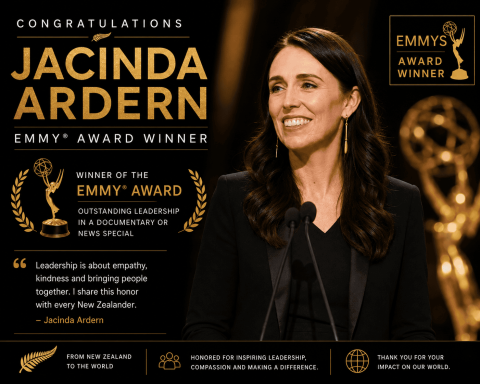
Jacinda Ardern’s rise, leadership, and abrupt departure from office have now been immortalized in Prime Minister, a documentary that has secured the highest honor at the 2026 News & Documentary Emmy Awards. Built on deeply personal footage captured by her partner Clarke Gayford, the film offers a rare dual portrait: a globally admired leader navigating crises and a private individual grappling with exhaustion, doubt, and responsibility. Its journey—from an unplanned archive of home videos to an internationally celebrated documentary—underscores the enduring global fascination with Ardern’s leadership style and the emotional cost of modern governance.
A Leadership Story Interrupted
When Jacinda Ardern stepped down in January 2023 at just 42, the announcement reverberated far beyond New Zealand. Her resignation—measured, composed, and final—came after a tenure defined by extraordinary pressure. She had steered the country through the Christchurch mosque attacks, the Whakaari/White Island volcanic disaster, and the Covid-19 pandemic, all while becoming only the second elected world leader in history to give birth while in office.
Yet behind the poise was depletion. Ardern openly acknowledged she had “nothing left in the tank,” a striking admission in a political culture that often rewards endurance over honesty. What remained unseen at the time, however, was that much of this period had been quietly documented—not by journalists or state media, but by her partner.
From Private Archive to Global Stage
Clarke Gayford’s recordings were never intended as a cinematic project. They began as fragments of personal memory during what he later described as one of the most difficult periods of their lives. Over time, this material—raw, unfiltered, and deeply intimate—became the backbone of Prime Minister, a 101-minute documentary directed by Michelle Walshe and Lindsay Utz.
The production drew from approximately 300 hours of footage, combining Gayford’s home videos with archival audio from New Zealand’s Political Diaries Oral History project. These recordings offered a unique structural device: Ardern, in retrospect, listens to her past reflections while interrogating her own decisions and emotional state.
The editorial achievement lies in the juxtaposition. On one side stands Ardern the stateswoman—composed, articulate, and globally admired. On the other is Jacinda the individual—frequently anxious, self-questioning, and navigating the private toll of public leadership. This duality forms the film’s emotional core and distinguishes it from conventional political documentaries.
A quietly powerful example captures Ardern at home, deliberating over what to wear for her resignation speech while discussing whether she should have delegated more effectively. It is a moment that distills the film’s thesis: even at the apex of power, leadership is profoundly human.
Festival Momentum and Commercial Traction
The documentary’s ascent to Emmy recognition began at the 2025 Sundance Film Festival, where it won the Audience Award for World Cinema Documentary—a notable signal of broad public resonance rather than purely critical acclaim.
From there, the film followed a structured distribution path:
A U.S. theatrical release in June 2025
Screenings at the New Zealand International Film Festival
A nationwide New Zealand rollout beginning September 25, 2025, where it generated $417,000 in its opening week, marking the strongest debut for a local documentary in seven years
Subsequent availability on streaming platforms, significantly expanding its global reach
By April 2026, the project had secured two Emmy nominations, culminating in a dual win—Best Documentary and Outstanding Politics and Government Documentary—at a ceremony held at Jazz at Lincoln Center in New York.
Outperforming Heavyweight Competition
The scale of the achievement becomes clearer when viewed against its competition. Prime Minister triumphed over a slate of documentaries centered on war, disaster, and systemic upheaval, including Hurricane Katrina: Race Against Time, Turning Point: The Vietnam War, and 2000 Meters to Andriivka.
That a character-driven political portrait from a small nation outperformed these large-scale narratives speaks to its universal appeal. The film does not rely on spectacle but on access—offering viewers something rarely granted: proximity to power without mediation.
Critical Divide: Intimacy Versus Depth
Despite its accolades, the documentary has not escaped scrutiny. Critics have pointed to a perceived imbalance between emotional storytelling and policy analysis. Some reviews characterized the film as “intimate but simplistic,” arguing that it largely sidesteps contentious issues such as:
New Zealand’s housing crisis
The Three Waters reform debate
The long-term implications of pandemic restrictions
The central critique is structural: proximity can limit perspective. With Gayford as a primary source of footage, the narrative inevitably carries an embedded bias.
Director Michelle Walshe has countered that the film was never intended as a policy audit. Instead, its aim was to humanize leadership at a time when political discourse often lacks empathy. She also emphasized editorial independence, noting that the filmmakers maintained control over the narrative despite Gayford’s involvement.
Importantly, Ardern herself reportedly accepted the portrayal without reservation, responding simply, “that’s me,” when viewing the film—an acknowledgment that lends credibility to its authenticity, even if not to its comprehensiveness.
Reframing Ardern’s Legacy
The Emmy victory has reignited debate over Ardern’s political legacy, particularly within New Zealand. Internationally, she remains emblematic of empathetic leadership, especially for her response to the Christchurch attacks, which drew widespread praise.
Domestically, the picture is more complex. Critics argue that her government fell short in key areas, particularly housing affordability and certain pandemic-era decisions that polarized public opinion.
The documentary—and now its global recognition—reintroduces these tensions on a larger stage. For supporters, it validates a leadership model grounded in compassion. For detractors, it risks reinforcing what they see as an overly favorable narrative.
A Milestone for New Zealand Storytelling
Beyond politics, the film represents a significant moment for New Zealand’s creative industry. Backed by major international players including HBO Documentary Films, CNN Films, and Magnolia Pictures, the project nonetheless retains strong local authorship through co-director Michelle Walshe.
This hybrid production model—local storytelling with global distribution—illustrates a pathway for smaller markets to achieve international cultural impact.
At its core, however, the film’s success stems from something far less strategic: a partner documenting lived experience during a period of extraordinary strain. That this private archive evolved into an Emmy-winning global narrative underscores the enduring power of authenticity in an increasingly curated media landscape.
- Log in to post comments
